Loading…
Claude Design
Summary
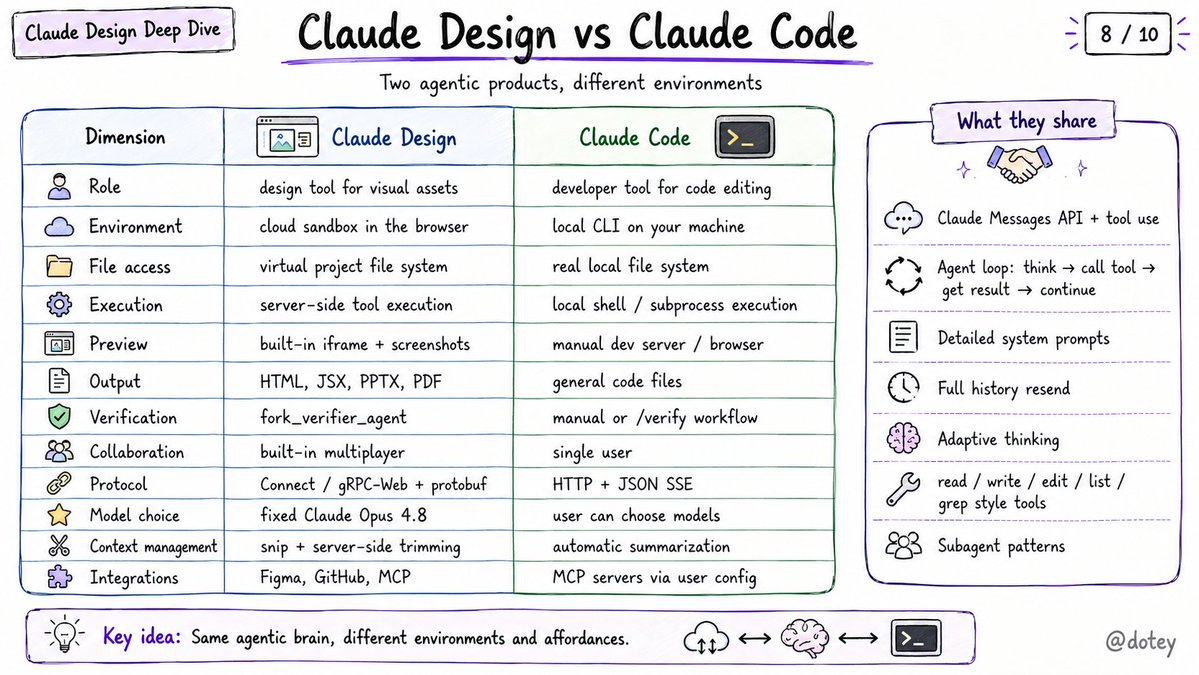
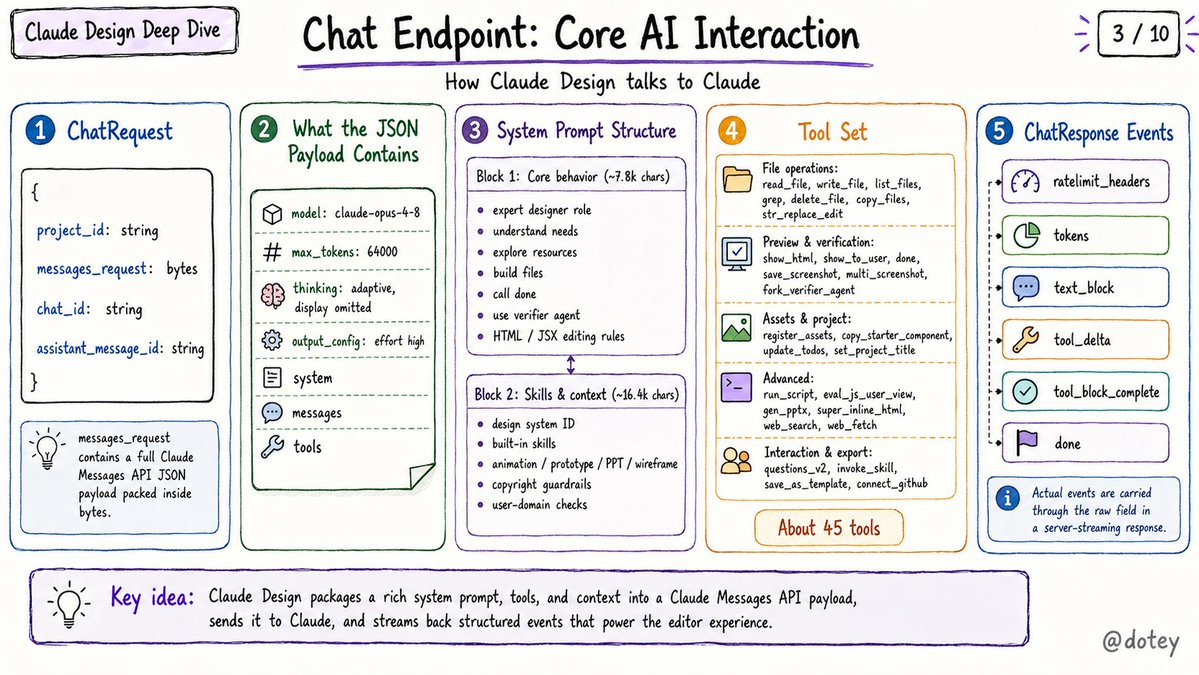
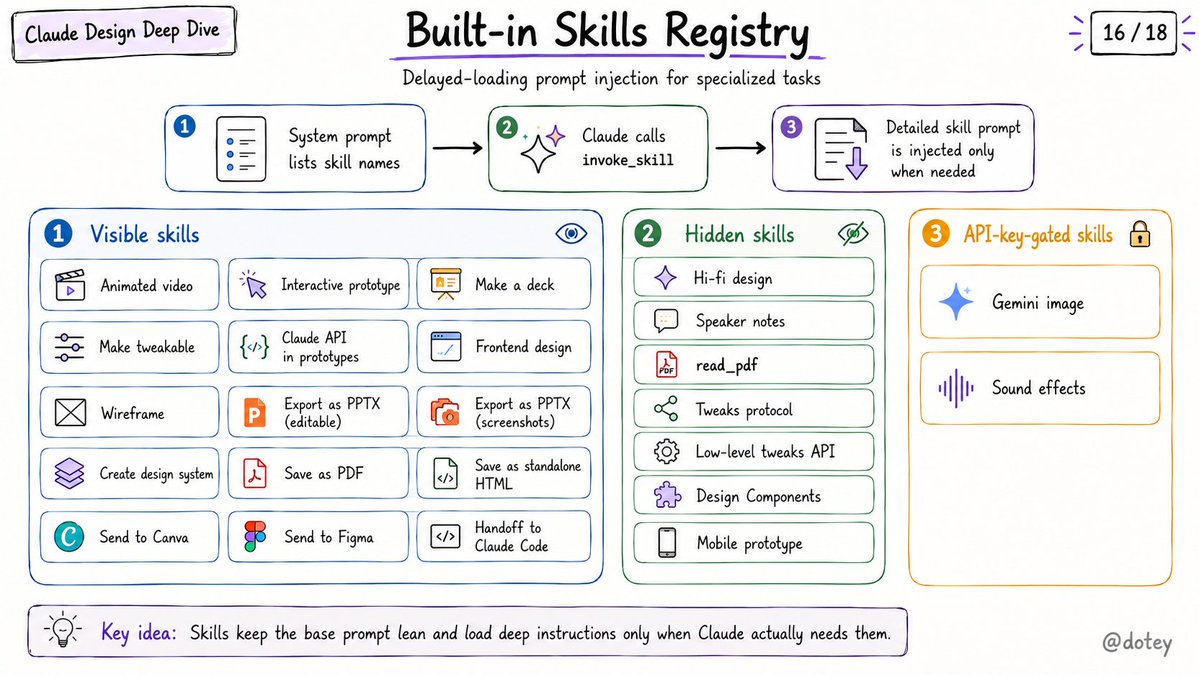
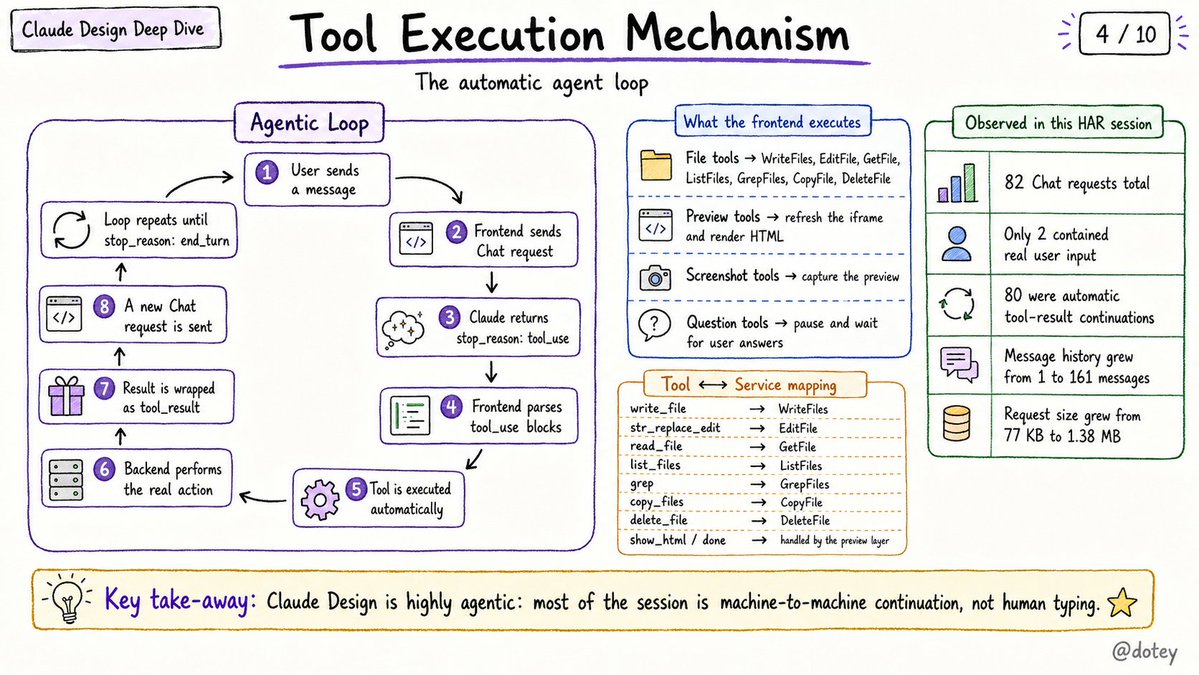
Claude Design is a complete agent runtime environment (an Agent Harness) developed by Anthropic. According to 宝玉 (@dotey), it ships a full runtime rather than a single-agent prompt wrapper. It is built on a browser and virtual machine architecture, provides 45 tools and 24 built-in skills, and operates through an Agentic Loop. Functionally it is comparable to Claude Code, but differs in its underlying infrastructure: Claude Code runs in a developer’s local environment, while Claude Design runs inside a browser and a virtual machine.
Key Points
- It is a harness, not just an agent. Claude Design contains the full scaffolding an agent needs — tool surface, skill library, runtime, controls, and a loop — not merely one model doing one task.
- Provides a full Agent Harness with an integrated agentic loop execution model.
- Contains 45 tools and 24 built-in skills, enumerated by the author.
- Architecture is browser- and virtual-machine-based, contrasting with Claude Code’s local/CLI approach.
- Allows for agent autonomy and task execution without external orchestration.
- The comparison with Claude Code is architectural, not cosmetic: the author’s point is that they differ mainly in where the harness runs, not in whether one exists.
- There is live disagreement: a quoted skeptic reports a team that studied the product for nearly a month, found “no sign of a harness,” and concluded it looked like a single agent at work, asking where the customization actually lives. The skeptic’s identity is disputed across sources — one attributes the quote to @FanVancoo, another to @BroVandesign — so the attribution is not settled here.
Concepts
- Agent Harness: The complete runtime environment that hosts and manages autonomous agents, including tool execution, skill invocation, runtime, controls, and loop control. It is the surrounding scaffolding that turns a model into an autonomous worker.
- Agentic Loop: The core execution pattern where an agent iteratively perceives its state, reasons, takes actions using tools/skills, and observes results until completion — the perceive → act → observe cycle.
- Skills: Pre-defined capabilities bundled into the agent, enabling specialized behaviors without external configuration; Claude Design has 24 built-in skills.
- Tools: Atomic functions the agent can call to interact with external systems or perform specific operations; Claude Design exposes 45 tools.
- Browser + VM runtime: The execution substrate for Claude Design, contrasted with Claude Code’s local/CLI setting.
- Claude Code: The reference point for comparison; it shares the agentic-loop execution model but runs in the developer’s local environment.
- @dotey (宝玉): Author of the harness claim.
- Quoted skeptic: The dissenting researcher/team reporting no visible harness. Attribution is unresolved: the quote is credited to @FanVancoo by one source and to @BroVandesign by another; both descriptions concern a team or researcher finding no obvious harness structure.
Details
According to a social media post by @dotey (宝玉), Claude Design possesses a fully self-contained agent runtime environment — what the author terms an Agent Harness. The comparison to Claude Code is made on a single axis: Claude Code is a harness that lives in the developer’s local environment, while Claude Design is a harness built on a browser and a virtual machine, which provides isolation and flexibility. Everything else — the loop, the tooling, the skills — is structurally the same kind of machinery. The harness includes 45 tools and 24 built-in skills, allowing the agent to handle a wide range of tasks directly. Execution follows an agentic loop pattern, meaning the agent continuously cycles through observation, decision, and action until the goal is met.
The post grounds the claim in concrete counts: 45 tools available to the agent, 24 built-in skills, and execution driven by an Agentic Loop. Taken together, these are presented as sufficient evidence that a harness is present, since a harness is precisely the thing that supplies a tool surface, a reusable skill set, and a control loop around the model.
Rendering diagram…
The post also notes that Claude Design may not be immediately recognized as a harness because its internals are not exposed; the user observing the system sees only a single agent working autonomously. A quoted skeptic reports nearly a month of team investigation with no indication of a harness, describes the observed behavior as a single agent performing the work, and asks where the harness customization is located. The identity of this quoted skeptic is reported differently across sources and remains unresolved: one source attributes the quoted exchange to @FanVancoo, while another attributes it to @BroVandesign. This page therefore records both attributions rather than choosing one; the substance of the quoted claim is the same either way. In both accounts, the disagreement is essentially one of observability: the harness claim rests on enumerated tools/skills and an inferred loop, while the skeptic’s view rests on the absence of visible harness structure from the outside.
The exchange is a small case study in how agent products are evaluated. Counting tools and skills and identifying a loop is one way to demonstrate that a system is a harness; black-box behavioral observation is another, and the two can disagree. The framing also places Claude Design and Claude Code in the same architectural family, differing by runtime substrate rather than by category.
See also: Dai Yusen's AI Investment and Ecosystem Analysis, yopedia, RLM Agents, Agent Harness, Agent Core Loop, Model Context Protocol, DeepSeek TUI, AI coding agents 2026 landscape, Claude Code background agents
Sources · 1
- [1]x.comhttps://x.com/dotey/status/2064749906800111892 · fetched 2026-11-15