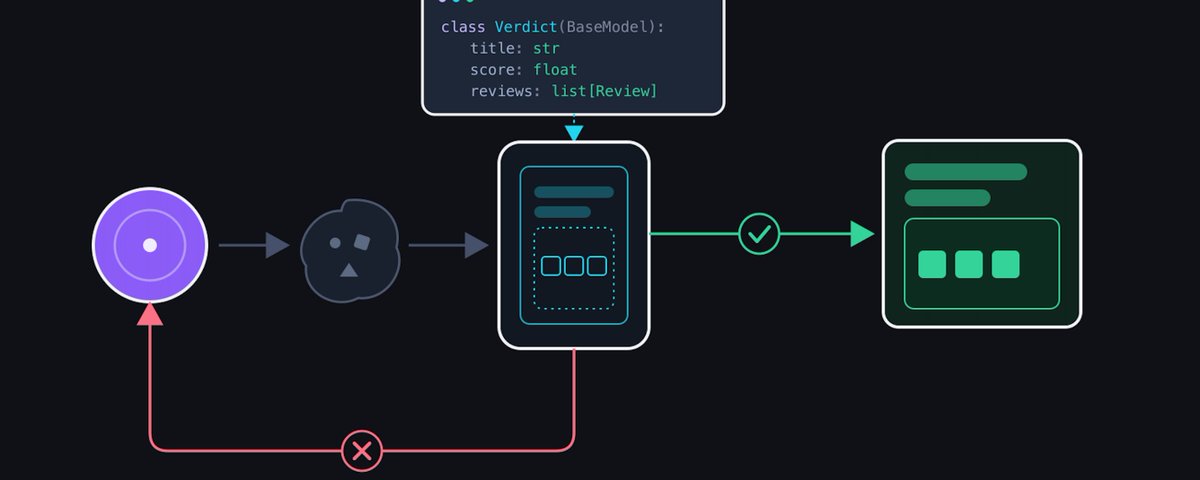
Summary
Adopting structured outputs — such as JSON schemas — for communication makes RLM-based agents more reliable and maintainable. This pattern applies both to inter‑agent communication in multi-agent systems and to intra‑agent recursive reasoning where a model feeds its own output back into its context. In both settings, constraining outputs to a predefined schema reduces parsing errors, eliminates ambiguity, and stabilizes the agent's behavior over multiple steps.
Key Points
- Structured outputs enforce a predictable contract between agents, eliminating ambiguity in multi-agent conversations.
- In recursive loops, structured outputs reduce drift, hallucination, and error accumulation by anchoring each step to a formal schema.
- Healthier agent systems result from reduced parsing failures, simpler error handling, and clearer traceability.
- Benefits include easier validation, debugging, and tracking of intermediate states.
- The pattern is lightweight — it requires only a prompt change and a parser — and mirrors best practices in software engineering (e.g., typed APIs).
- This approach is especially valuable in autonomous systems where agents must coordinate or self‑correct without human intervention.
Concepts
- RLM Agent – The acronym has two competing definitions:
- Reinforcement Learning from Model agent – an agent built on reinforcement learning from models, often used in multi-agent frameworks where policies are learned through interaction.
- Recursive Language Model agent – an agent that uses a model’s own previous output as input to iteratively refine answers, enabling multi‑step reasoning and self‑correction.
- Structured Outputs – Data formatted according to a predefined schema (e.g., JSON, Protocol Buffers) that an agent produces or consumes, as opposed to unstructured text.
- Inter‑agent Communication – Exchange of messages between multiple autonomous agents; when structured, it becomes machine‑verifiable and schema‑compliant.